📈 Compound Interest Calculator
See how an investment grows when interest earns interest. Choose daily, monthly, quarterly or yearly compounding and add regular contributions.
Also known as: Interest on Interest · Investment Growth · Compounding Interest Calculator · Compound Calculator · Figure Compound Interest Calculator · Compound Interest Calculated Daily · Compounding Calculator · Daily Compound Interest Calculator
Loading calculator…
How to use the Compound Interest Calculator
- Enter your values in the fields above — the defaults show a worked example.
- The result updates instantly as you type; change any input to compare scenarios.
- Copy or share the result, or open a related calculator below.
How it's calculated
A = P(1 + r/n)nt + PMT × ((1 + r/n)nt − 1) ÷ (r/n), where n is compounding periods per year and contributions are made each period.
Frequently asked questions
How often should interest compound?
What is the rule of 72?
Is the Compound Interest Calculator free?
How accurate is the Compound Interest Calculator?
Can I use the Compound Interest Calculator on my phone or offline?
Read more about the Compound Interest Calculator
What compound interest is
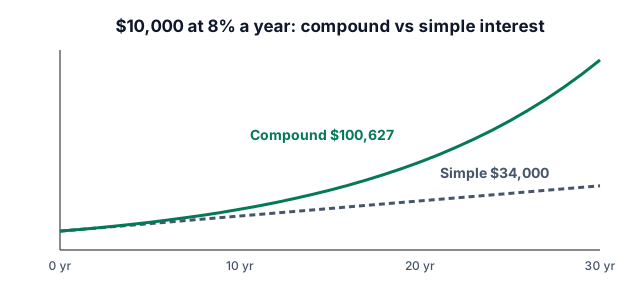
Compound interest is interest earned on previous interest. Each period, the balance grows by the rate, and the next period’s interest is calculated on the new, larger balance. Over long periods this creates exponential growth: $10,000 at 8% becomes about $21,600 after 10 years, $46,600 after 20 and $100,600 after 30 — versus $34,000 with simple interest.
Read more
The formula
Future value = P × (1 + r/n)n×t, where P is the starting amount, r the annual rate, n the number of compounding periods per year and t the number of years. With regular contributions C at the end of each period, add C × ((1 + r/n)n×t − 1) ÷ (r/n).
How compounding frequency matters
More frequent compounding helps, but less than people expect. At 5% for 10 years, $10,000 grows to $16,289 compounded annually, $16,470 monthly and $16,487 daily. The rate and the time invested matter far more than the frequency.
The rule of 72
Divide 72 by the annual rate to estimate how many years it takes to double your money: about 9 years at 8%, 12 years at 6%, 24 years at 3%. It also works in reverse for inflation — at 3% inflation, prices double in about 24 years.
Starting early beats saving more
Someone who invests $200 a month from age 25 to 35 and then stops can end up with more at 65 than someone who invests $200 a month from 35 to 65, at the same 7% return, because the early money has decades longer to compound. Time is the most powerful input in this calculator.
Real vs nominal returns
Returns quoted by banks and funds are nominal. To see growth in today’s purchasing power, subtract inflation: a 7% return with 3% inflation is roughly a 4% real return. The inflation calculator converts future values back into today’s money.
When to use the Compound Interest Calculator
Use the Compound Interest Calculator for compound interest with any compounding frequency and optional regular deposits, with a year-by-year growth table. It is one of 111 free finance calculators, and pairs well with the Simple Interest Calculator, Investment Calculator, Rule of 72 Calculator and Savings Calculator.
Tips for accurate results
Use the rate and fees from your actual offer or statement rather than an advertised rate, run a best case and a worst case, and remember that taxes, insurance and fees can change the real cost. Results are estimates, not financial or tax advice.
Sources and review
Sources:
- Consumer Financial Protection Bureau
- Federal Reserve — consumer resources
- SEC Investor.gov — financial tools
Every calculator is checked against published reference values before release and re-reviewed when laws, rates or guidelines change. Read our methodology and editorial policy. Found a problem? Report it — we fix errors quickly.
More Finance Calculators
Popular calculators
Results are estimates for information only and are not financial or tax advice. Calculations run privately in your browser.